
Botticelli
Biography
Sandro Botticelli (c. 1445 – 1510) was an Italian painter of the Early Renaissance, renowned for his exquisite work that melded classical mythology with Christian themes. Born in Florence, Botticelli became a leading figure under the patronage of Lorenzo de' Medici, the powerful ruler and cultural benefactor of Florence. This close relationship with the Medici family significantly influenced Botticelli’s artistic direction, allowing him access to the intellectual and artistic circles that shaped Renaissance humanism.
Botticelli's work is characterised by its linear elegance, delicate colour palette, and graceful figures, as seen in masterpieces such as The Birth of Venus and Primavera. His paintings contributed to the revival of classical antiquity in art, reflecting the Renaissance ideals of beauty, harmony, and balance. Botticelli's impact on the Renaissance lies not only in his technical skill and poetic vision but also in his ability to visually interpret the era's philosophical and cultural currents, leaving a lasting legacy on both his contemporaries and future generations of artists.
Most significant works
Sandro Botticelli is one of the most influential artists of the Italian Early Renaissance. He produced numerous masterpieces that have left a lasting imprint on art and culture that still have resonnance today. Some of his most significant works located in Rome and Florence include:
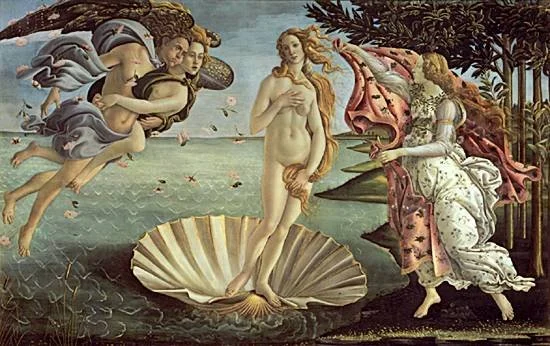
The Birth of Venus (mid 1480’s)
Sandro Botticelli’s The Birth of Venus depicts the goddess Venus emerging fully grown from the sea on a shell, attended by wind gods and a handmaiden ready with a cloak. Executed in tempera on canvas, the painting synthesizes classical mythology and Renaissance ideals of beauty: Venus’s elongated, flowing form and the sinuous rhythm of the composition emphasize grace, harmony, and an idealized human divinity rather than strict naturalism.
The narrative source for The Birth of Venus is classical mythology, primarily Ovid’s Metamorphoses and related ancient accounts that describe Venus (Aphrodite) arising from the sea foam. Botticelli translates these literary sources into a visual allegory of divine love and beauty, informed also by contemporary Neoplatonic ideas circulating in Florence that associated physical beauty with spiritual and intellectual perfection.
The likely patron was Lorenzo di Pierfrancesco de’ Medici, a member of the Medici family’s junior branch and a notable supporter of Botticelli. The painting was created in the mid-1480s during a flourishing period of Florentine art and culture closely tied to Medici patronage.
The painting is housed in the Galleria degli Uffizi in Florence, where it remains one of the most celebrated masterpieces of the Italian Renaissance.
The Primavera (late 1470’s – early 1480’s)
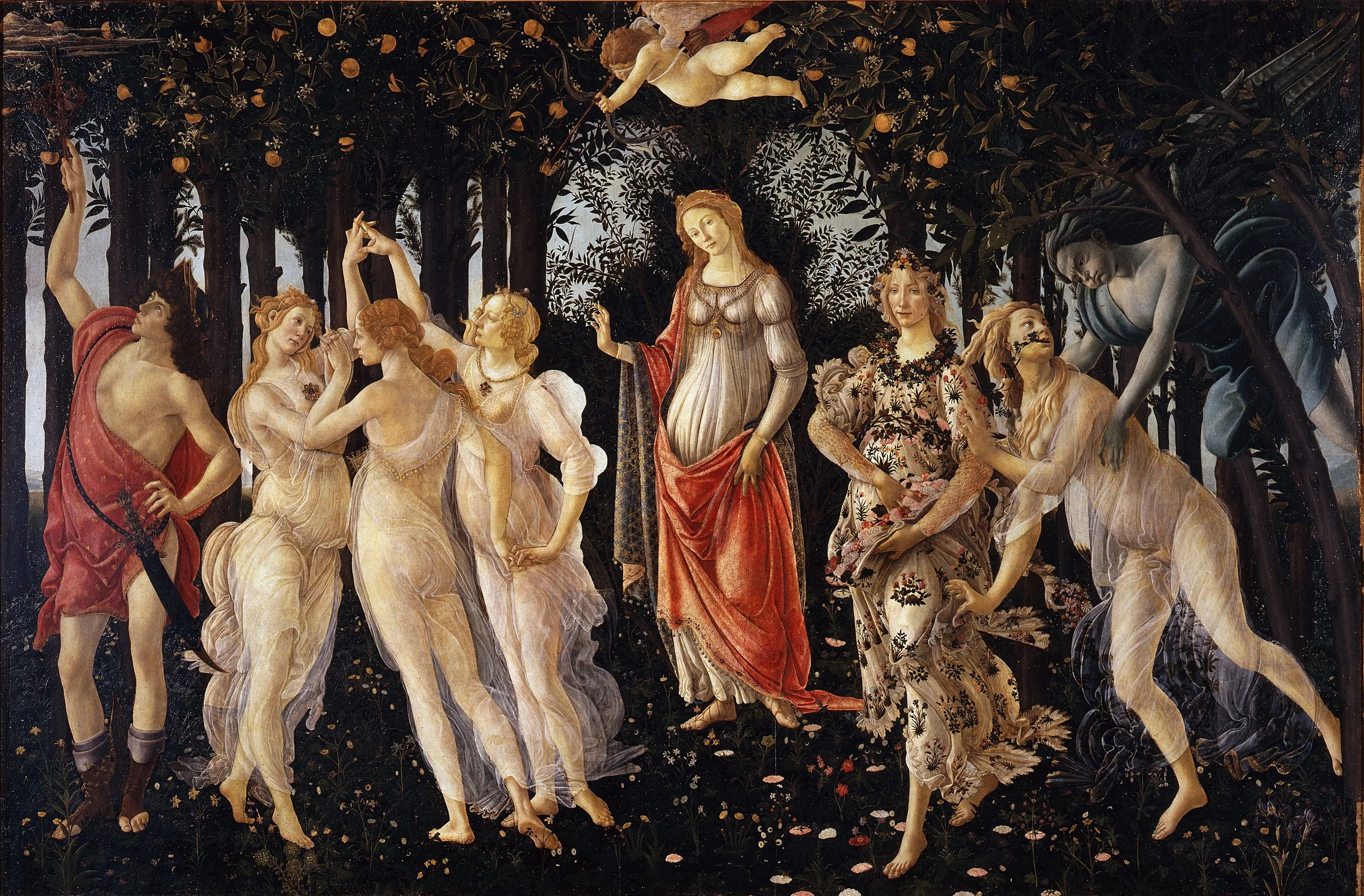
Sandro Botticelli’s Primavera is a tempera-on-panel painting completed around 1482 that portrays an idealized garden scene populated by mythological figures: Venus stands at the center beneath a grove of orange trees, attended by the Three Graces to her left and Mercury to her far left, while to the right Zephyrus, the west wind, pursues and seizes the nymph Chloris, who is transformed into the floral goddess Flora. The scene unfolds as an allegory of spring, love, and fertility, rendered in Botticelli’s characteristic linear elegance, elongated figures, delicate floral detail, and a measured, lyrical composition that blends classical motifs with Renaissance aesthetics.
The narrative source is classical mythology filtered through humanist and Neoplatonic interpretations current in Renaissance Florence—texts such as Ovid’s Metamorphoses and contemporary poetry informed the painting’s mythic episodes and its symbolic readings as an allegory of divine and earthly love, spiritual rebirth, and civic harmony.
The most likely patron was Lorenzo di Pierfrancesco de’ Medici of the junior Medici branch, who is thought to have commissioned the work for a domestic context, possibly as part of a marriage chamber. Primavera is now housed in the Uffizi Gallery in Florence.
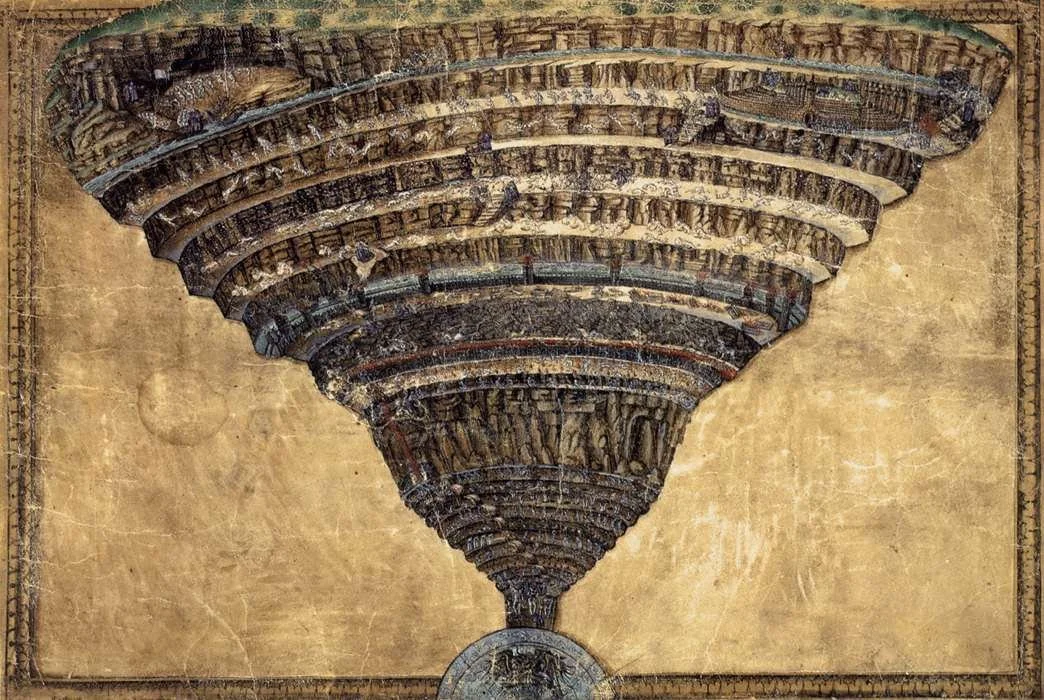
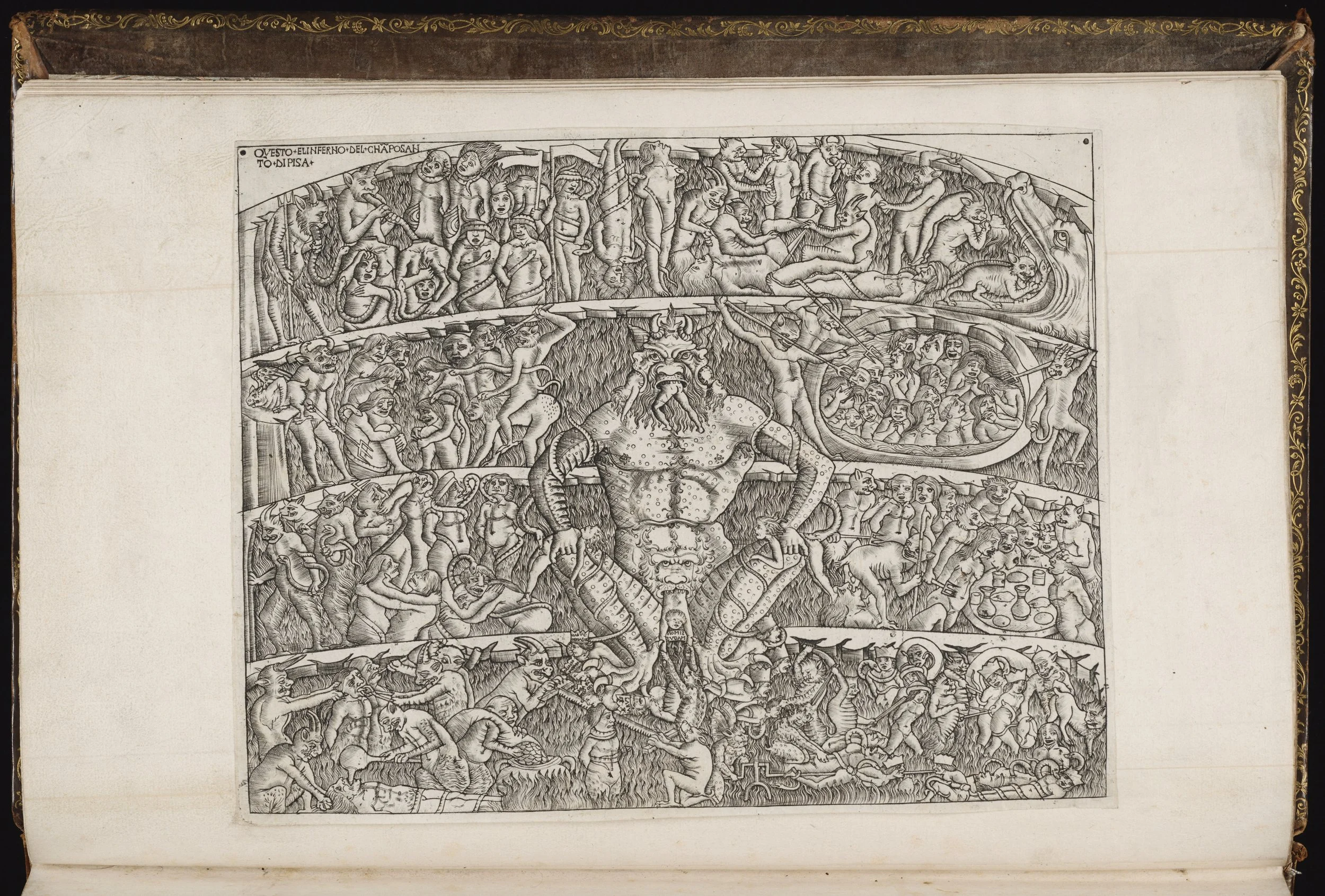
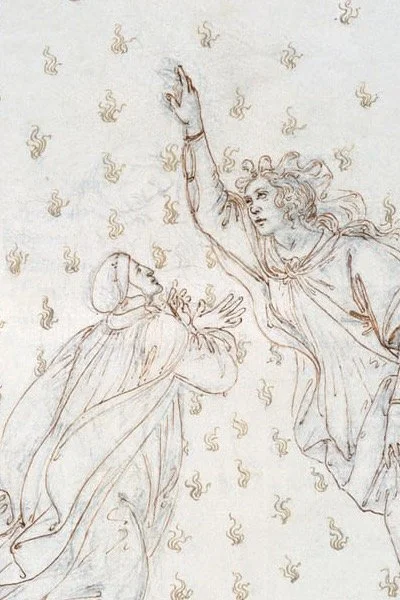
The Map of Hell (mid 1480’s - mid 1490’s)
Sandro Botticelli produced a series of detailed pen-and-ink drawings to illustrate Dante Alighieri’s Divine Comedy — chiefly for a deluxe manuscript of the poem. The surviving corpus attributed to Botticelli for this project numbers about 92 drawings (some sources cite roughly 80–100), executed in metalpoint, pen-and-ink, and wash. The sheets vary from small studies to more finished, highly finished compositions that reinterpret episodes from the Inferno, Purgatorio, and Paradiso with Botticelli’s characteristic linear grace, elongated figures, and expressive, often theatrical arrangements.
Most of these drawings are now dispersed among several collections:
The Vatican Library (Biblioteca Apostolica Vaticana) holds a substantial group of the Dante drawings, including many fine, large-scale sheets.
The Kupferstichkabinett in Berlin owns several important sheets.
Other examples are in the Uffizi (Florence), the British Museum (London), the Burlington Fine Arts Club and other private or institutional collections across Europe.
Botticelli undertook the Dante project late in his career, probably in the 1480s–1490s and continuing into the early 1500s. Reasons for his engagement include genuine literary and spiritual interest in Dante’s poem, a broader Florentine revival of Dante’s work as a cultural emblem, and his association with humanist circles that prized manuscript illumination and classical-literary projects. The commission appears to have been initiated by a member of the Medici circle — traditionally Lorenzo di Pierfrancesco de’ Medici is cited as patron of other Botticelli works from the same period — but the Dante drawings are not tied to a single, clearly documented patron in the way many panel paintings are. Some sheets were likely preparatory studies for an intended illuminated deluxe manuscript of the Divine Comedy; others may have been produced for collectors or Botticelli’s own interest in Dante’s themes.