Filippo Brunelleschi
Biography
Filippo Brunelleschi (1377–1446) was an Italian engineer, architect, and sculptor whose innovations helped define the early Renaissance in Florence. Born into a goldsmithing family, he trained initially as a goldsmith and sculptor before turning to architecture and engineering. His combination of artistic sensibility, practical engineering skill, and rigorous study of classical models made him one of the period’s most influential figures.
Contribution to the Renaissance
Revival of classical principles: Brunelleschi studied Roman ruins and classical proportion, adapting ancient architectural ideas for contemporary use. His work helped shift Italian architecture away from Gothic forms toward clarity, order, and measured harmony rooted in antiquity.
Development of linear perspective: He is widely credited with the first systematic formulation and practical demonstration of linear perspective in painting and drawing. By devising a method to represent three-dimensional space on a flat surface using a single vanishing point, Brunelleschi provided artists a reliable visual tool that transformed pictorial representation during the Renaissance.
Engineering innovations: Brunelleschi solved complex structural problems with inventive engineering, blending mathematics, empirical observation, and mechanical ingenuity. His methods advanced construction techniques and made ambitious architectural projects feasible.
Best remembered for
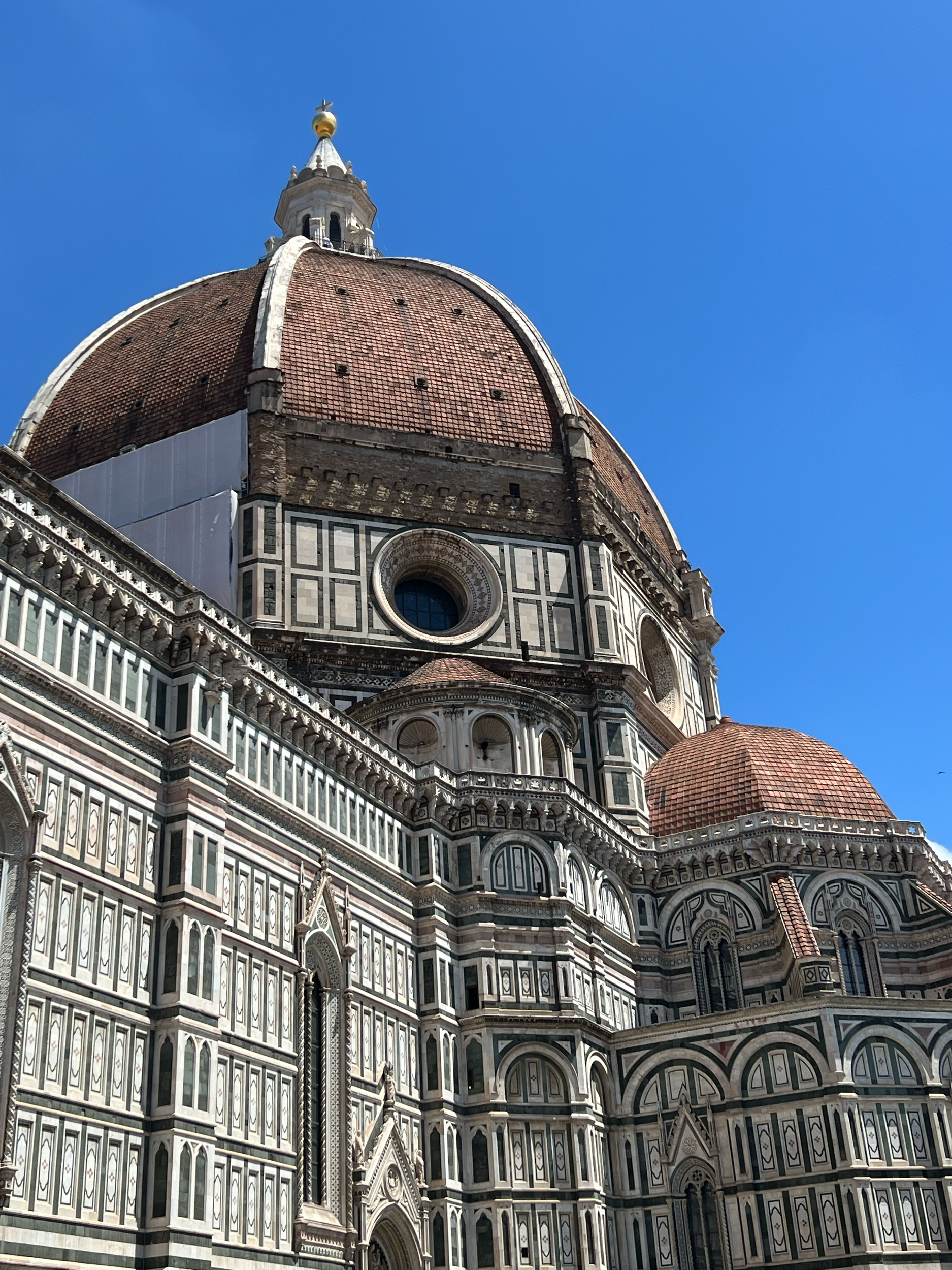
The dome of Santa Maria del Fiore (Florence Cathedral): Brunelleschi’s crowning achievement is the design and construction of the cathedral’s massive double-shell dome (completed 1420–1436). Facing the problem that the octagonal drum was too wide for conventional Gothic scaffolding and buttressing, he devised a novel octagonal dome built without a full wooden centering, using a herringbone brick pattern, a system of horizontal rings and chains to contain thrust, and an inner and outer shell connected by ribs. The dome was the largest of its kind when completed and remains a landmark of engineering and architectural daring.
Demonstration of linear perspective: His experiments—famously including a perspective panel showing the Baptistery of Florence and public demonstrations using mirrors and painted panels—established practical rules for perspective that influenced painters and architects across Italy.
Legacy
Brunelleschi’s blend of technical mastery and classical aesthetics laid foundational principles for Renaissance architecture and taught generations how to marry form with structural intelligence. His dome became both a physical symbol of Florentine civic pride and a touchstone for architects seeking to reconcile beauty and engineering. Alongside contemporaries such as Donatello and later figures like Leon Battista Alberti, Brunelleschi helped to shape an architectural language that privileged proportion, clarity, and human-centered design—hallmarks of the Renaissance.
Most significant works
Filippo Brunelleschi revolutionized Renaissance architecture with the dome of Florence Cathedral (Santa Maria del Fiore), a daring engineering feat that combined a double-shell design and herringbone brickwork to span the vast octagonal drum without centering. He co-founded the development of linear perspective, formalized in his lost experiments and reconstructed through his Perspective Room, which transformed representation in painting and architectural drawing. His Ospedale degli Innocenti (Foundling Hospital) established a modular, harmonious façade using classical orders and proportion, setting a template for civic architecture rooted in humanist ideals. In projects like the Pazzi Chapel and the Sagrestia Vecchia (Old Sacristy) at San Lorenzo, Brunelleschi distilled geometric clarity, mathematic order, and serene spatial composition, defining the language of High Renaissance architecture.
The Duomo (1420-1436)
Brunelleschi’s dome for Florence Cathedral (the Duomo) was completed through a combination of technical innovation, organisational skill and political determination. In the early 15th century the cathedral’s octagonal crossing required a vast masonry dome to cap the nave—an unprecedented span (about 42 metres) and height that traditional wooden centring would have made impractical. After a public competition and years of debate, Filippo Brunelleschi (together with collaborator Lorenzo Ghiberti initially) proposed a daring solution: a double-shell dome built without full wooden centring, using a pointed (ogival) profile, horizontal and herringbone brick courses for self-support during construction, and a system of internal rings and chains to contain lateral thrust.
Construction began in 1420. Brunelleschi developed specialised machinery—revolving hoists, ox-powered hoists and novel scaffolding—to lift materials and lay courses efficiently. The two concentric shells (an inner shell of lighter, closely packed bricks and an outer weatherproof shell) were connected by ribs and the internal chain system that functioned like modern tension rings. The dome was effectively completed and sealed by 1436, with the lantern added by Brunelleschi shortly before his death and finished in 1461.
Legacy beyond the Renaissance
Structural innovation: Brunelleschi’s method for spanning large spaces without full centring demonstrated that masonry could achieve much larger, self-supporting forms. His use of a double-shell and tension chains influenced later dome builders and expanded the vocabulary of large-scale masonry construction.
Engineering as integrated practice: The project fused design, engineering, and invention. Brunelleschi’s combination of analytical thinking, empirical testing and custom machinery helped shift architectural practice toward combining theoretical geometry with practical mechanics—an approach foundational to later structural engineering.
Influence on dome design: The Duomo directly inspired subsequent domes across Europe. Renaissance architects like Bramante, Michelangelo and others studied its proportions and engineering; Michelangelo’s dome for St Peter’s Basilica adopted a double-shell logic and visible ribs, while later neoclassical and Baroque domes echoed its monumental presence and structural strategies.
Urban and symbolic impact: The success of Brunelleschi’s dome elevated the role of monumental domes as civic and symbolic markers. City-states and nation-states thereafter used domes to assert religious, political and cultural identity, from cathedral skylines to state capitols.
Long-term engineering lessons: Modern restorers and engineers still study the Duomo to understand historical materials, stress distribution in masonry, and long-term performance of large unreinforced structures. The project presaged later methods for dealing with thrust, ring reinforcement and layered shell constructions used in 19th- and 20th-century architecture and engineering.
The Florence Duomo stands as both an artistic icon and a turning point in architectural history: a proof-of-concept that monumental, innovative structural solutions could be devised and executed, seeding technical and aesthetic developments that shaped architecture well beyond the Renaissance.
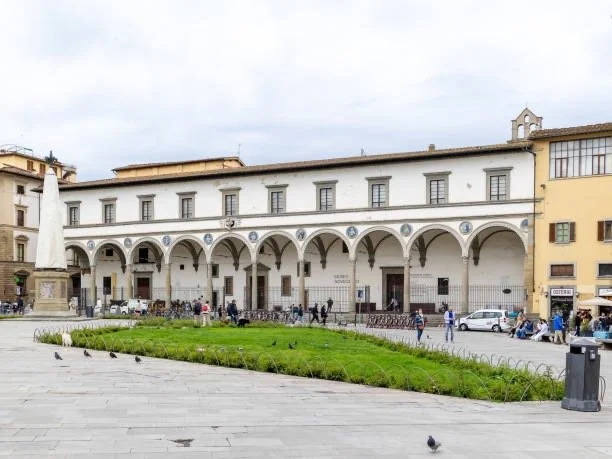
Oespedale degli Innocenti (1420-1436)
Ospedale deli Innocenti by Filippo Brunelleschi sits on Piazza della Santissima Annunziata in central Florence, a few blocks north of the Duomo. Commissioned in the early 15th century as a foundling hospital, its long loggia of round arches supported on slender columns and a harmonious proportional system mark a clear departure from the Gothic idiom prevailing at the time.
Brunelleschi’s façade introduced measured symmetry, linear clarity and the use of classical motifs—blind arcades, pilasters, and an articulated cornice—that became foundational to Renaissance architecture. The building’s rational geometry and human-scaled proportions informed subsequent Florentine palaces, churches and civic projects, establishing a language of balance and restraint that spread across Italy and shaped the built vocabulary of the Renaissance.