Raphael
Biography
Raphael (Raffaello Sanzio da Urbino) was an Italian painter and architect born in 1483 in Urbino. Renowned for his exquisite technique and clarity of form, he became one of the leading figures of the High Renaissance. Raphael’s work is characterised by harmony, balance, and graceful composition, traits that made his art a model of classical perfection.
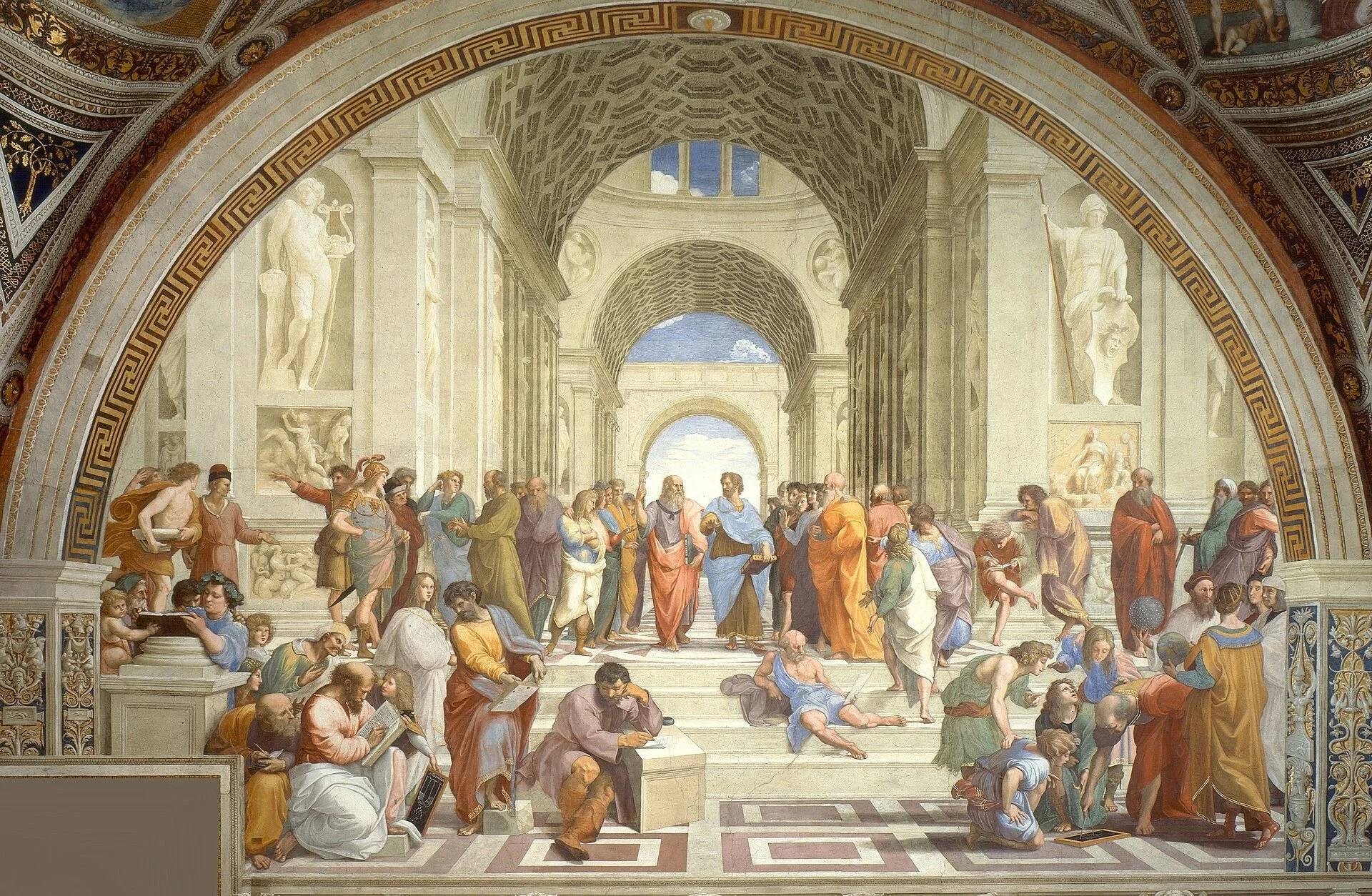
His significance to the Renaissance lies in his mastery of perspective and his ability to combine the ideal beauty inherited from classical antiquity with a deep humanism. Notable works such as The School of Athens embody the intellectual spirit of the Renaissance, celebrating philosophy, art, and science. Beyond painting, Raphael contributed to architecture, influencing designs for St. Peter’s Basilica in Rome.
Throughout his relatively short life—he died in 1520 at the age of 37—Raphael profoundly shaped Renaissance art, inspiring generations of artists who followed his synthesis of technical skill and philosophical insight.
Most significant works
Raphael’s harmonious compositions and mastery of perspective set a new standard for balance and clarity in Renaissance painting. His graceful figures and serene expressions influenced generations of artists seeking idealized beauty and noble humanism. Raphael’s frescoes and altarpieces synthesized classical ideals with contemporary innovation, shaping the visual language of the High Renaissance.
Some of his most significant works include:
The School of Athens (1509 - 1511)
The School of Athens is a masterful fresco that celebrates classical learning and the intellectual spirit of the Renaissance. Painted between 1509 and 1511, it depicts an idealized architectural setting populated by the great philosophers, mathematicians, and scientists of antiquity—Plato and Aristotle dominate the central vanishing point, while figures such as Socrates, Euclid (or possibly Archimedes), Pythagoras, and Diogenes animate the scene. Raphael populated the composition with gestures and interactions that convey distinct modes of thought: metaphysics and idealism on one side, empirical inquiry and practical reasoning on the other. The fresco is admired for its harmonious composition, precisely calculated perspective, graceful figures, and the convincing individuality Raphael gave to each thinker.
Location and patronage
The School of Athens occupies one of the main walls of the Stanza della Segnatura, a room in the Vatican Palace that served as Pope Julius II’s private library and study.
Pope Julius II commissioned Raphael to decorate the Stanze (the papal rooms) as part of a broader program to project papal authority and humanist learning.
Influence and importance
The painting epitomizes High Renaissance ideals: balanced composition, technical mastery of perspective and anatomy, and the synthesis of classical antiquity with contemporary Christian culture.
It became influential by providing a visual model for how art could embody intellectual ideals—artists and patrons thereafter sought similarly grand, reasoned compositions that fused classical references with modern portraiture and idealized form.
Raphael’s treatment of space and gesture helped codify principles of pictorial organization used by generations of painters, and his dignified portrayal of knowledge reinforced the Renaissance conviction that art and learning were mutually enriching.
The School of Athens thus stands as both a celebration of ancient thought and a statement of the Renaissance belief in human reason and unity of knowledge.