Titian
Biography
Tiziano Vecellio (c. 1488/90–1576), known in English as Titian, was the foremost painter of the Venetian school and one of the most influential artists of the Italian Renaissance. Born in Pieve di Cadore in the Republic of Venice, he trained in Venice under Giovanni Bellini and with the workshop of Giorgione, absorbing their colouristic sensibilities and compositional innovations. Over a career spanning more than seven decades, Titian developed a distinctive approach to colour, texture and psychological depth that reshaped painting across Italy and beyond.
Titian’s mastery of chromatic richness and subtle gradations of tone — often called colourito — allowed him to create luminous surfaces and a sense of atmosphere that distinguished Venetian painting from the linear emphasis of Florentine art. He experimented with oil paint techniques, using layered glazes and broad, confident brushstrokes to achieve fleshy modelling, vibrant skin tones and shimmering fabrics. This painterly handling gave his works a sensuous immediacy and emotional resonance, influencing contemporaries and later generations, including the Baroque masters.
His prolific output included portraits, religious altarpieces and mythological scenes. Notable works such as Assumption of the Virgin, Bacchus and Ariadne, Venus of Urbino and numerous state and private portraits demonstrate his range: from monumental sacred commissions for Venetian churches to intimate court portraits for emperors, popes and European princes. Titian’s portraits established new standards for psychological presence and dignity; he could convey status, temperament and inner life with economical gestures and subtle lighting.
Titian also advanced pictorial composition and narrative clarity. In mythological paintings he combined classical themes with contemporary colouristic drama, while his late works moved toward increasingly loose, expressive brushwork and ambiguous forms that presaged aspects of 17th- and 19th-century painting. His relationship with patrons—especially the Habsburg emperor Charles V and Philip II of Spain—elevated the status of the artist as a cultivated courtly professional and secured his international reputation.
Impact and legacy:
Revolutionised the use of colour and glazing in oil painting, making chromatic effects central to pictorial expression.
Elevated portraiture by blending psychological insight with painterly splendour; his model influenced portrait traditions across Europe.
Helped define Venetian visual identity, distinct from Florentine emphasis on disegno (drawing), shifting debates about the primacy of colour versus line in art theory.
His late, freer brushwork anticipated Baroque dynamism and later painters’ interest in expressive surface treatment.
Titian died in Venice in 1576, probably a victim of the plague. He left a vast body of work and a workshop that carried his innovations forward. Today he is celebrated not only for individual masterpieces but for reshaping painting’s technical and expressive possibilities during the Renaissance, making colour, materiality and painterly touch central to Western art’s development.
Most significant works
Titian revolutionized Venetian painting with masterpieces like "Assumption of the Virgin," combining monumental composition, vibrant colour, and dynamic movement to elevate religious narrative. His mythological canvases—most notably "Bacchus and Ariadne" and "Venus of Urbino"—blend sensuality, psychological depth, and sumptuous colour to redefine secular portraiture and allegory. Late works such as "Pietà" and "Flaying of Marsyas" reveal a bold, expressive brushwork and sombre tonal shifts that anticipate Baroque drama and modern painterly freedom.
Assumption of the Virgin (1516-1518)
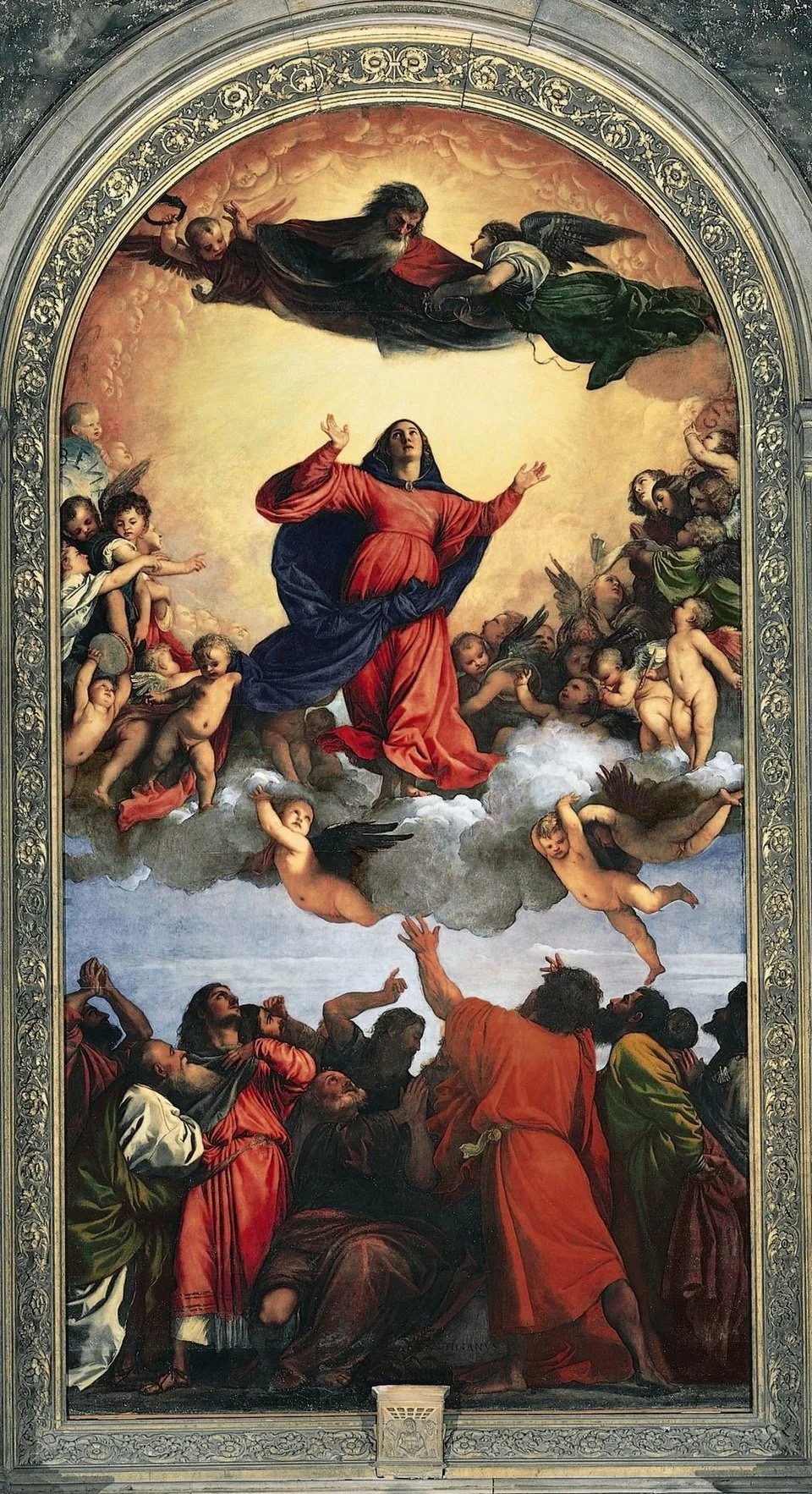
Titian’s The Assumption of the Virgin (1516–1518) shows the Virgin Mary rising into heaven while the apostles watch in awe. The lower register depicts the apostles around an empty tomb, some reaching upward, others expressing wonder or grief. In the centre, a group of angels lifts Mary, who is shown ascending with flowing robes and an upward gaze, bathed in light. Above her, God the Father awaits amid radiant clouds and more angels, completing the vertical movement from earth to divine realm. Titian uses rich colours, dramatic light, and energetic composition to convey spiritual triumph and emotion.
The painting is the main altarpiece in the Basilica di Santa Maria Gloriosa dei Frari (the Frari) in Venice, Italy.
Bacchus and Ariadne (1520-1523)
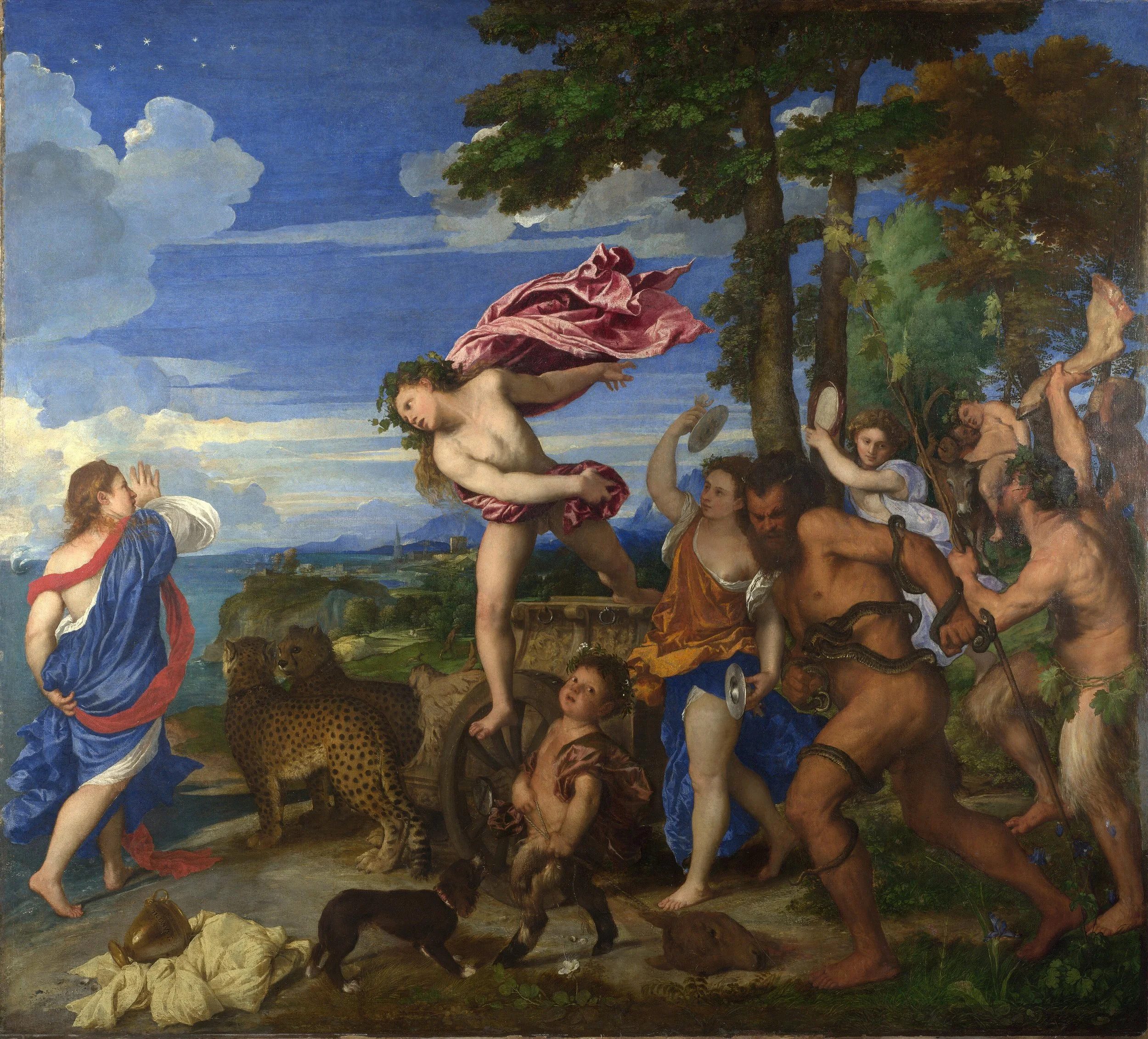
Titian’s painting "Bacchus and Ariadne" shows the moment when the god Bacchus finds the abandoned princess Ariadne on a beach. Ariadne stands on a rocky shore, surprised and reaching out, while Bacchus leaps from a chariot drawn by fierce, energetic animals. Around them are dancing followers of Bacchus, colourful fabrics, and a bright blue sky. The painting is full of movement, rich colours, and dramatic light.
The painting is currently in the National Gallery in London.